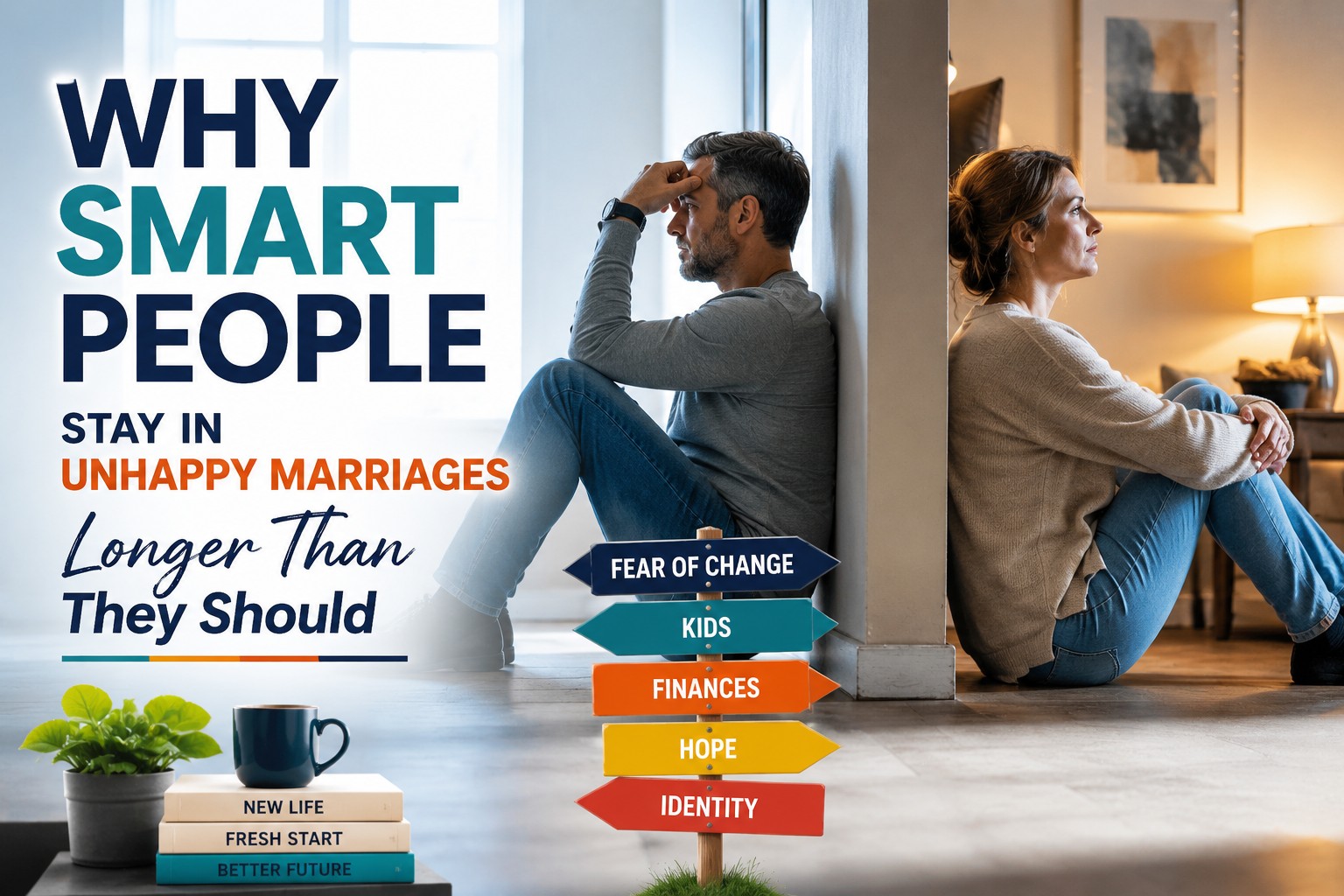
One of the biggest misconceptions about divorce is the idea that people leave unhappy marriages quickly or impulsively.
In reality, many people stay in unhappy marriages for years — sometimes decades — before ever seriously considering divorce.
And often, those people are thoughtful, successful, intelligent individuals.
So why does it happen?
The answer is usually much more complicated than people realize.
It Is Rarely Just About Love
When people from the outside look at an unhappy marriage, they often ask:
“Why don’t they just leave?”
But marriage is rarely that simple.
People build entire lives together:
- Children
- Homes
- Financial systems
- Friend groups
- Traditions
- Shared identities
- Future plans
Leaving a marriage is not just ending a relationship. It can feel like dismantling an entire life.
Fear of the Unknown Is Powerful
Even when someone knows they are unhappy, uncertainty can feel terrifying.
People often worry about:
- Financial stability
- Parenting schedules
- Living alone
- Starting over
- Dating again
- How divorce will affect the children
- What life will actually look like afterward
And sometimes the fear of the unknown feels worse than remaining in a difficult situation.
Many People Keep Hoping Things Will Improve
This is extremely common.
People often stay because they believe:
- “Maybe this is just a rough season.”
- “Things used to be good.”
- “If we just communicate better…”
- “Maybe once work stress improves…”
- “Maybe once the kids are older…”
Hope can keep people trying for a very long time.
And that hope is not irrational. Many marriages do improve through counseling, communication, and effort.
But sometimes people stay so focused on the possibility of change that they stop paying attention to the reality of the relationship as it currently exists.
Children Complicate Everything
For many parents, the children become the single biggest reason they stay.
Parents often worry about:
- Breaking up the family
- Not seeing the children every day
- Emotional effects on the kids
- Shared custody
- Financial impact on the household
Many people convince themselves: “I’ll stay until the kids are older.”
Sometimes that comes from love and sacrifice.
Sometimes it comes from fear.
Often it is both.
Identity Plays a Bigger Role Than People Realize
Long marriages become deeply tied to identity.
People may see themselves as:
- A spouse
- Part of a team
- A provider
- A parent in a two-parent household
The idea of losing that identity can feel overwhelming.
After years together, many people do not even remember what life looked like before the relationship.
Smart People Often Rationalize Staying
Interestingly, intelligent people are sometimes better at explaining away unhappiness.
They may:
- Minimize problems
- Focus on practical considerations
- Convince themselves things are “not bad enough”
- Compare themselves to worse relationships
They become highly skilled at functioning within unhealthy dynamics while appearing successful from the outside.
Fear of Judgment Keeps People Stuck
Divorce can carry emotional and social stigma.
People may fear:
- Disappointing family
- Religious or cultural judgment
- Looking like they “failed”
- Public embarrassment
- Friends taking sides
This is especially true for people whose identity is strongly tied to family image, professional success, or community standing.
Some People Do Not Realize How Much Chronic Stress They Are Living With
When conflict becomes normal, people sometimes stop recognizing how emotionally exhausted they are.
Living in constant tension can slowly become:
- Familiar
- Predictable
- Routine
It is often not until separation occurs that people realize how much stress they had been carrying for years.
Staying Longer Does Not Mean Someone Is Weak
This is important.
People stay for many reasons:
- Love
- Hope
- Fear
- Loyalty
- Financial concerns
- Parenting concerns
- Emotional attachment
- Religious beliefs
Every relationship is complicated, and every person’s threshold is different.
Some marriages can and should be repaired. Others reach a point where staying creates more harm than leaving.
The Goal Is Not Always Divorce
Not every unhappy marriage should end.
Sometimes:
- Counseling helps
- Communication improves
- Conflict decreases
- The relationship heals
But avoiding difficult conversations indefinitely often leads to deeper resentment, emotional distance, and prolonged unhappiness.
Final Thoughts
Most people who stay in unhappy marriages are not irrational or weak.
They are human.
They are balancing emotions, fear, hope, children, finances, identity, and uncertainty — often all at once.
And many people wait far longer than others realize before finally deciding something has to change.
Sometimes the hardest decision is not leaving, it’s asking yourself whether the relationship is still working at all.
Considering Divorce or Unsure About Your Next Steps?
If you are struggling with questions about your marriage, speaking with an experienced family law attorney at Grinke Stewart Law can help you better understand the legal and practical realities of divorce, even if you have not decided whether to move forward.
You do not have to have everything figured out before asking questions. Call us today at 469-598-2001 to discuss your situation and options.