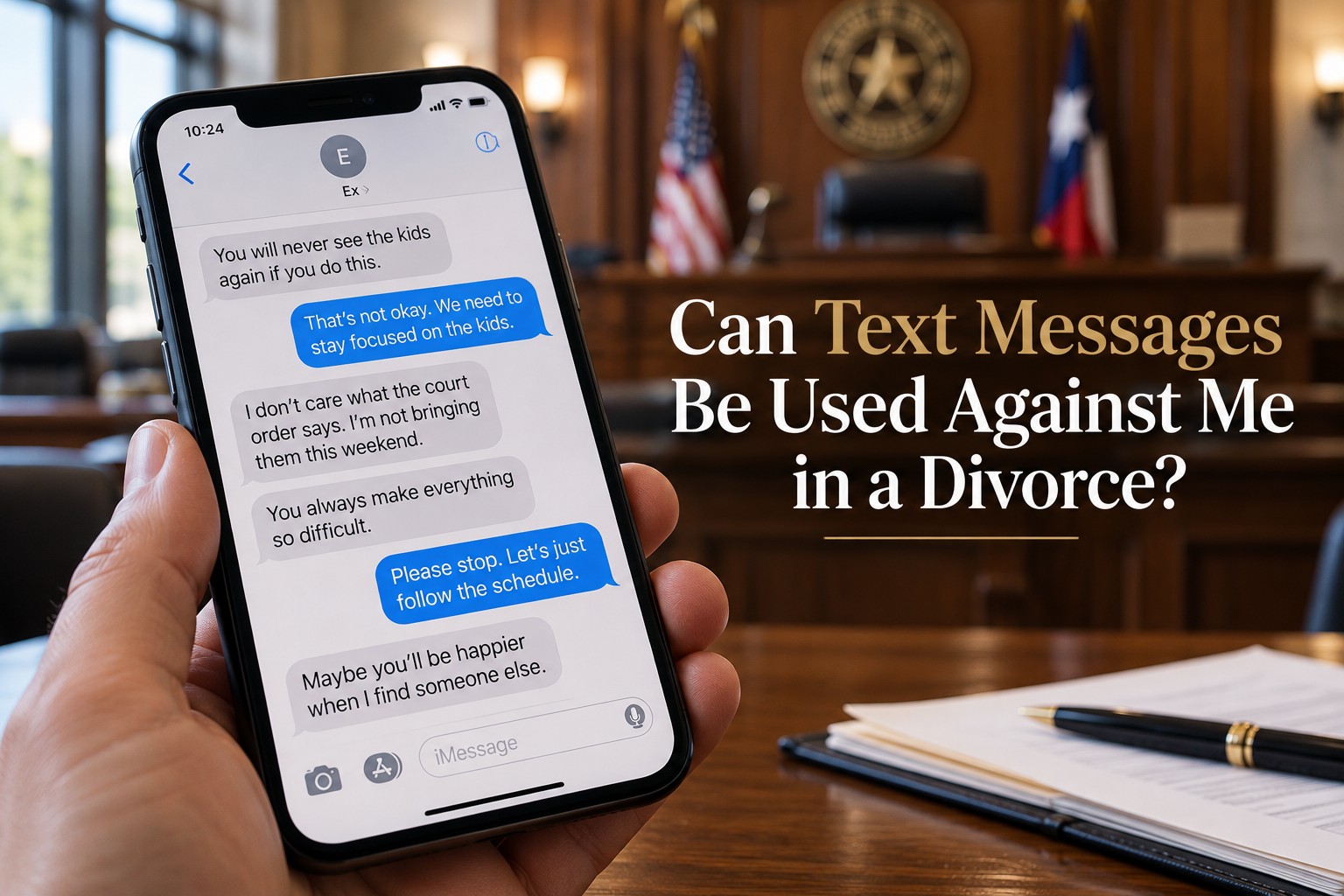
You get into an argument with your spouse and send an angry text message. Maybe you say something you don’t really mean. Maybe you threaten to take the kids. Maybe you make an accusation, use some colorful language, or send a message you immediately regret. A few months later, you’re sitting in your attorney’s office preparing for a divorce hearing, and that same text message appears in a stack of evidence.
Can your spouse actually use those messages against you in court?
In Texas, the answer is yes, potentially. Text messages, emails, social media messages, and other electronic communications can become important evidence in divorce and child custody proceedings. And sometimes, what you say in a moment of anger can have consequences long after the argument is over.
Are Text Messages Admissible in a Texas Divorce?
Potentially, yes. Texas courts can admit text messages into evidence when they satisfy the applicable rules of evidence. However, simply having a screenshot of a text message doesn’t automatically mean it will be admitted. The message must be relevant to an issue in the case, properly authenticated, and otherwise admissible under the Texas Rules of Evidence.
For example, a text message might be relevant because it concerns:
- Parenting decisions or possession of the children;
- Threats, harassment, or abusive behavior;
- Financial transactions or hidden assets;
- Admissions about income, property, or spending;
- Allegations of infidelity;
- Agreements or disagreements between the parties; or
- Statements that contradict someone’s testimony.
In some cases, a single text message can be significant. In others, a series of messages may help establish a pattern of behavior.
How Do You Prove Who Actually Sent a Text Message?
One of the most common questions is whether a screenshot is enough to prove that someone sent a particular message. Under Texas Rule of Evidence 901, evidence generally must be authenticated before it can be admitted. That means the party offering the message must provide sufficient evidence to establish that the message is what they claim it is.
Authentication may involve testimony from someone who received the message, the phone number involved, the surrounding conversation, identifying information within the message, or other circumstances connecting the communication to its alleged sender. For example, if a message comes from your spouse’s phone number, discusses information only your spouse would likely know, and fits within an ongoing conversation, those circumstances may help establish authenticity. However, a contact name appearing at the top of a screenshot does not necessarily prove who actually wrote the message.
Can Text Messages Affect Child Custody?
Absolutely. In a Texas custody case, the court’s primary consideration when determining conservatorship, possession, and access is the best interest of the child. Text messages may provide evidence relevant to that determination.
- “I’m not letting you see the kids this weekend.”
- “I don’t care what the court order says.”
- “I’m going to make sure the kids hate you.”
- “If you don’t give me what I want, you’ll never see them again.”
Those messages could become important evidence concerning the parent’s conduct, willingness to follow court orders, or ability to support the child’s relationship with the other parent. On the other hand, messages demonstrating cooperation, flexibility, and a willingness to prioritize the children’s needs may help establish a parent’s credibility.
How you communicate with your co-parent can become part of the evidence about how you co-parent.
What About Angry or Inappropriate Text Messages?
Divorce can bring out strong emotions. People say things when they’re frustrated, scared, or angry that they might never say under ordinary circumstances. But a text message creates a record of those emotions. A judge may eventually read messages containing insults, threats, accusations, or inappropriate language. That doesn’t mean one angry message automatically determines the outcome of a case. Courts consider evidence in context.
But repeated hostile communications may be more difficult to explain, particularly when the messages contradict a parent’s claims about their behavior. For example, telling the judge that you always communicate respectfully with your co-parent may become problematic if opposing counsel produces dozens of messages demonstrating otherwise.
Credibility matters, and your text messages can either support or undermine it.
Can Text Messages Be Used to Prove Someone Is Hiding Money?
Yes, potentially. Text messages can also be important in the financial aspects of a divorce. Suppose a spouse sends messages discussing:
- Transferring money to another account;
- Concealing a bonus or other income;
- Purchasing property without telling the other spouse;
- Giving money to a romantic partner;
- Hiding business revenue; or
- Moving assets before filing for divorce.
Those communications may help establish facts relevant to the identification, characterization, valuation, or division of marital property. Texas law requires courts to divide the marital estate in a manner that is just and right, considering the rights of each party and any children of the marriage. A message about a financial transaction does not necessarily prove wrongdoing by itself, but it may lead to additional documents or evidence.
Can My Spouse Obtain My Text Messages During Discovery?
Potentially. During a divorce, the parties may exchange requests for documents and electronically stored information through the discovery process. Depending on the issues in the case, relevant text messages may be requested.
This can include communications with your spouse, family members, friends, business associates, or other individuals. And don’t assume that messages are automatically protected from discovery simply because they are personal. The Texas Rules of Civil Procedure permit discovery of relevant, nonprivileged information, subject to applicable limits and objections. Of course, not every message on your phone is automatically discoverable. Relevance, privilege, proportionality, and other discovery rules can affect what must be produced.
Your attorney can help determine what information is responsive to a proper discovery request.
What About Deleted Text Messages?
This is where people can make a serious mistake. Some individuals believe that deleting messages from their phones means those messages can never be discovered. That isn’t necessarily true.
Depending on the device, messaging service, backups, and other circumstances, deleted messages may remain available through other sources or may sometimes be recoverable. More importantly, intentionally deleting relevant messages after a duty to preserve them has arisen can create significant legal problems.
Texas Family Code authorizes temporary restraining orders in divorce cases prohibiting the destruction or alteration of relevant text messages and other electronically stored information. Deleting relevant evidence may also raise issues concerning spoliation of evidence.
If you are involved in a divorce or reasonably anticipate litigation, speak with your attorney before deleting potentially relevant communications.
What If My Ex Only Shows the Judge Part of the Conversation?
This is another common problem. Imagine a lengthy text exchange in which one spouse repeatedly provokes the other. After numerous messages, the frustrated spouse finally responds with something inappropriate. The other spouse takes a screenshot of that one response and attempts to present it as though it occurred without any context. That’s why preserving complete conversations can be important.
Depending on the circumstances and applicable evidentiary rules, additional portions of a conversation may be relevant to understanding what was actually said and why. If your ex produces a screenshot that you believe is misleading, provide your attorney with the complete conversation rather than assuming the judge will automatically recognize that something is missing.
Are Messages Through Co-Parenting Apps Different?
Parents sometimes believe that communicating through applications such as OurFamilyWizard or TalkingParents means those messages cannot be used against them. That is not correct. Communications through co-parenting applications may also become evidence in custody proceedings. In fact, some applications are specifically designed to maintain records of communications between parents.
The advantage of these applications is not that the messages are confidential or protected from court proceedings. Rather, they can help organize communications, document exchanges, and create a more reliable record of what was said. The same advice applies whether you’re communicating through a co-parenting application, text message, or email: Write every message as though a judge may eventually read it.
Can My Text Messages Actually Help My Case?
Yes. Not every message is damaging. Sometimes text messages are among the strongest pieces of evidence supporting a parent’s position. For example, messages may document:
- Efforts to arrange parenting time;
- Attempts to resolve disagreements;
- Requests for information about the children;
- Compliance with custody orders;
- Agreements concerning expenses;
- Efforts to communicate respectfully; or
- Attempts to address concerns without escalating conflict.
A consistent history of reasonable, child-focused communication may be useful when the other parent makes allegations that are inconsistent with those communications. The goal should not be to manufacture evidence. It should be to communicate appropriately and preserve an accurate record.
Five Things to Remember Before Sending Your Next Text
If you’re going through a divorce or custody dispute, consider these five practical suggestions.
- Don’t respond immediately when you’re angry. Not every message requires an immediate response. If you’re upset, give yourself time to consider what actually needs to be said.
- Keep your messages focused on the issue. If you’re discussing the children’s school schedule, discuss the school schedule. Avoid turning a simple logistical exchange into an argument about the marriage.
- Avoid threats, insults, and personal attacks. Even when you believe the other parent is behaving unreasonably, responding with hostile language rarely helps resolve the situation.
- Don’t assume your messages are private. A message sent to another person may eventually be produced during discovery or offered as evidence, subject to applicable legal rules.
- Preserve relevant communications. If litigation is pending or reasonably anticipated, don’t delete potentially relevant messages. If you receive messages that may be important to your case, discuss appropriate preservation methods with your attorney.
Final Thoughts
So, can text messages be used against you in a Texas divorce? Yes, text messages can become important evidence concerning child custody, financial issues, credibility, and other disputed matters. But not every screenshot is automatically admissible, and not every angry message is going to determine the outcome of your case. The relevance, authenticity, context, and substance of the communications all matter.
The best approach is to remember that the messages you send today may be examined months, or even years, later. Before hitting send, ask yourself one simple question, “Would I be comfortable with a judge reading this message out loud in court?” If the answer is no, you may want to reconsider what you’re about to send.
Questions About Evidence in Your Texas Divorce?
Text messages, emails, social media communications, and other electronic evidence can play an important role in contested divorce and child custody cases. At Grinke Stewart Law PLLC, we help clients throughout North Texas understand how electronic communications may affect their cases, identify relevant evidence, and prepare for contested hearings and trials. If you’re facing a divorce or custody dispute and have questions about messages that you or your spouse have exchanged, understanding how that evidence may be used is an important part of developing your legal strategy.