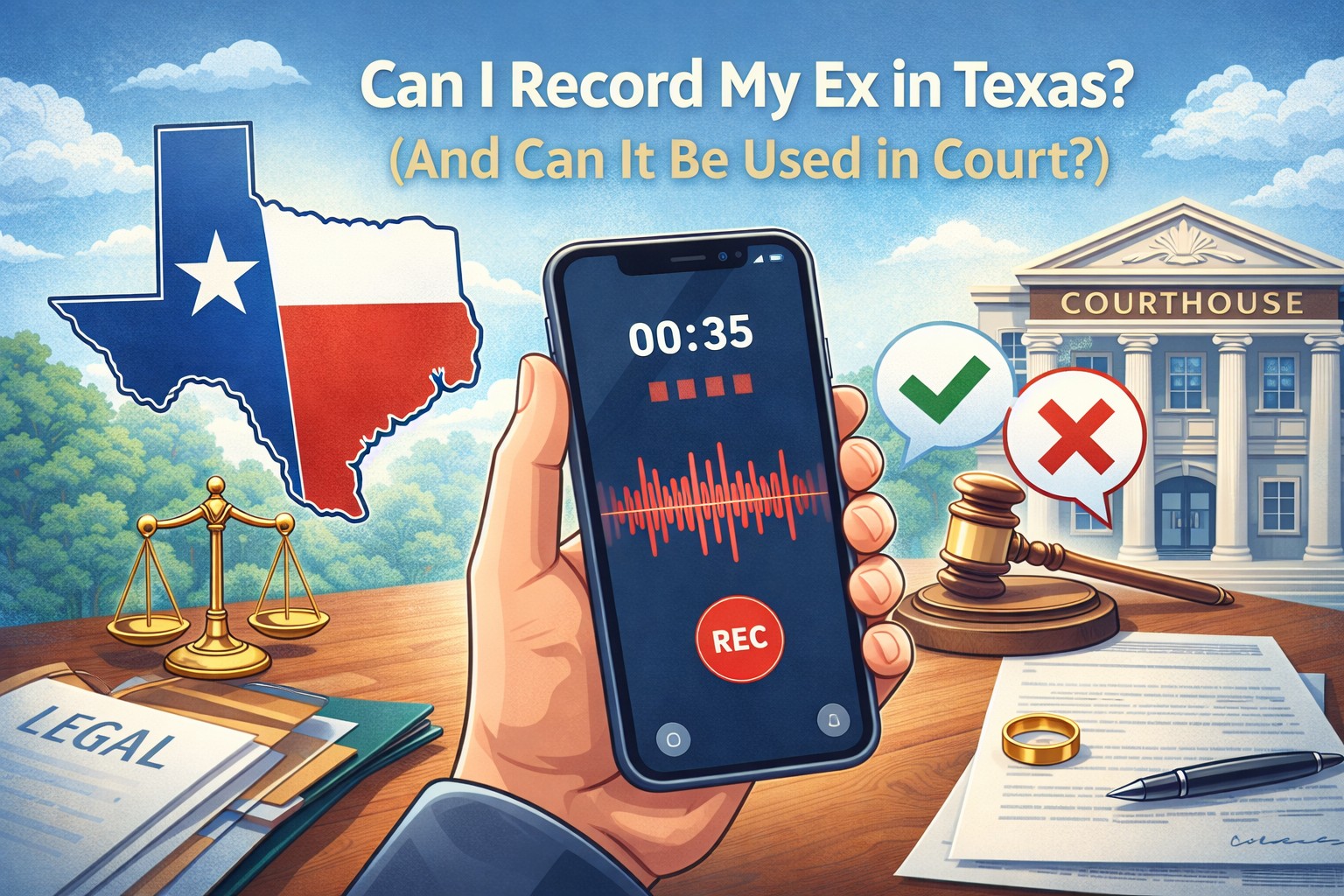
In custody and divorce cases, many parents eventually ask the same question:
“Can I record my ex if they’re saying or doing something inappropriate?”
The short answer in Texas is: sometimes, yes.
But the longer answer depends on how the recording was made, who was involved in the conversation, and whether it violates other laws or court orders.
Understanding the rules before hitting the “record” button is important, because recordings that are made improperly can create legal problems rather than help your case.
Texas Is a “One-Party Consent” State
Texas follows what is called a one-party consent law for recording conversations.
This means that a conversation can legally be recorded if at least one person involved in the conversation consents to the recording.
In practical terms, this usually means:
- If you are part of the conversation, you can generally record it without telling the other person.
- If you are not part of the conversation, recording it may violate state or federal law.
For example:
✔ Legal: Recording a phone call between you and your ex.
❌ Potentially illegal: Recording a conversation between your ex and someone else when you are not part of the conversation.
What About Recording Phone Calls?
The same rule typically applies to phone calls.
If you are participating in the call, you can generally record it without informing the other party.
However, problems can arise if:
- Someone else placed the call for you
- A third party recorded the call
- The recording occurred in a situation where privacy laws were violated
Always be cautious before recording calls involving people outside the conversation.
Recording Conversations Around Children
This is where things become more complicated.
Parents sometimes consider recording:
- Exchanges during visitation
- Conversations occurring near children
- Statements a child reports hearing
Recording situations involving children can raise additional concerns, especially if the child is unknowingly being recorded or is placed in the middle of conflict.
Courts often look unfavorably on actions that draw children deeper into litigation or parental disputes.
Before making recordings involving children, it is wise to discuss the situation with an attorney.
Can Recordings Be Used in Court?
Even if a recording was legally made, that does not automatically mean it will be admitted into evidence.
Courts still consider factors such as:
- Whether the recording is authentic
- Whether it is relevant to the issues in the case
- Whether it is unfairly prejudicial or misleading
Judges may allow recordings that show:
- Threats or harassment
- Violations of court orders
- Admissions relevant to the case
However, recordings that appear manipulative, incomplete, or taken out of context may carry little weight.
When Recordings Can Backfire
Many people assume recordings will strengthen their case, but they can sometimes have the opposite effect.
Recordings may hurt a case if they show:
- A parent provoking an argument
- A parent repeatedly recording routine interactions
- A parent attempting to “trap” the other party
Judges tend to focus on overall patterns of behavior, not isolated arguments.
What About Video Recordings?
Video recordings generally follow the same one-party consent rules when audio is involved.
However, additional issues can arise depending on where the recording occurs.
For example:
- Recording in public places is generally less restricted.
- Recording in private spaces where someone expects privacy can raise legal concerns.
Again, the context matters.
Best Practices Before Recording
If you believe a recording may be necessary in your case, consider these general guidelines:
- Make sure you are part of the conversation
- Avoid involving children in recordings
- Do not attempt to secretly record private conversations between other people
- Avoid provoking arguments just to capture a recording
- Speak with your attorney before relying on recordings as evidence
Taking these precautions can help prevent unintended legal problems.
Final Thoughts
Texas law does allow certain conversations to be recorded without the other person’s knowledge, but the rules are not always as simple as they seem. The legality and usefulness of a recording often depend on the circumstances in which it was made and how it is used in court.
Before making or relying on recordings in a custody or divorce case, consult with one of the experienced family law attorneys at Grinke Stewart Law who can help you understand the risks and whether the recording will actually help your case.