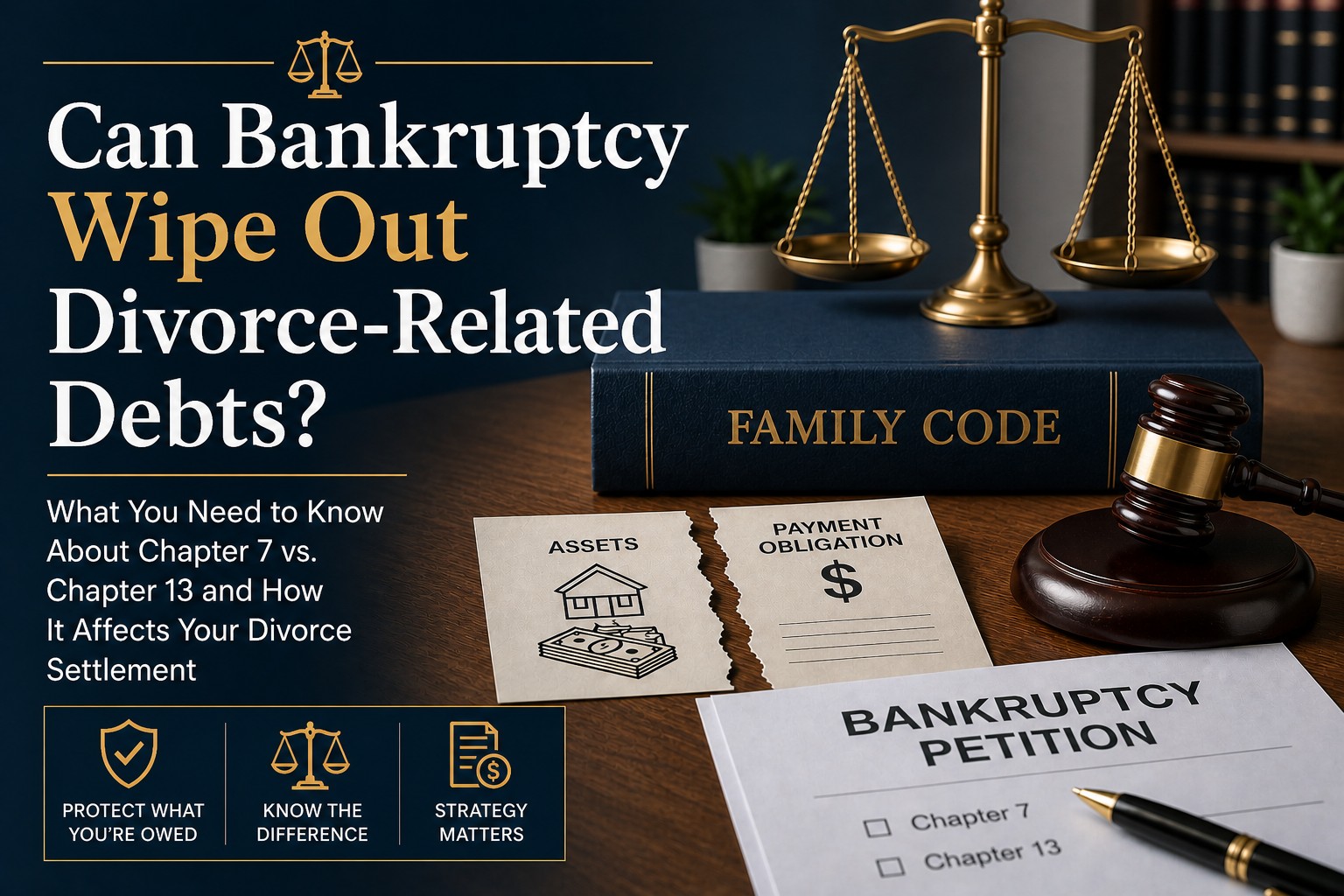
Divorce settlements often create ongoing financial obligations between former spouses. One spouse may be ordered to pay child support, spousal maintenance, attorney’s fees, a cash equalization payment, credit-card debts, mortgage payments, or retirement-account divisions. But what happens if the paying ex-spouse later files bankruptcy?
The answer depends on two major questions:
- Is the debt support, or is it property division?
- Did the ex-spouse file Chapter 7 or Chapter 13 bankruptcy?
Bankruptcy can affect some divorce-related debts, but it does not treat all divorce obligations the same.
1. Support Obligations Are Usually Not Dischargeable
The most protected category is a domestic support obligation, often called a “DSO.” Under the Bankruptcy Code, this generally includes debts owed to or recoverable by a spouse, former spouse, child, child’s parent, legal guardian, or governmental unit, if the debt is in the nature of alimony, maintenance, or support and was established by a divorce decree, separation agreement, court order, or similar process. See 11 U.S.C. § 101.
Examples usually include:
- Child support
- Spousal support / alimony / maintenance
- Certain support-related attorney’s fees
- Medical support or health-insurance obligations for a child
- Arrearages on support obligations
These debts are excepted from discharge under 11 U.S.C. § 523(a)(5).
Practical point
If the obligation is truly support, the paying spouse generally cannot eliminate it through either Chapter 7 or a standard completed Chapter 13 case. Bankruptcy may affect collection timing or procedure, but it usually does not erase the underlying support debt.
2. Property Division Debts Are Treated Differently
Divorce decrees often include debts that are not technically “support,” but instead divide marital property or debts. These may include:
- A cash equalization payment
- An obligation to pay the other spouse for equity in a home
- A requirement to assume or pay marital credit-card debt
- A requirement to refinance or hold the other spouse harmless on a mortgage
- Retirement-account division obligations
- Reimbursement obligations
- Property-settlement payments
These debts often fall under 11 U.S.C. § 523(a)(15), which covers debts owed to a spouse, former spouse, or child that are incurred in the course of a divorce or separation, but are not domestic support obligations.
This is where the bankruptcy chapter matters.
3. Chapter 7: Divorce Property-Settlement Debts Are Generally Not Discharged
In a Chapter 7 bankruptcy, both categories are generally protected:
| Type of divorce debt | Dischargeable in Chapter 7? |
|---|---|
| Child support | No |
| Spousal support / maintenance | No |
| Domestic support arrears | No |
| Property-division payment to ex-spouse | Usually no |
| Hold-harmless or indemnity obligation from divorce decree | Usually no |
| Divorce-related attorney’s fees in nature of support | Usually no |
The key provisions are 11 U.S.C. § 523(a)(5) for support and 11 U.S.C. § 523(a)(15) for many non-support divorce debts.
In Chapter 7, the Bankruptcy Code is relatively protective of former spouses and children. A debtor generally cannot use Chapter 7 to walk away from divorce-decree obligations owed to a former spouse or child, whether the obligation is support or a property-settlement debt.
4. Chapter 13: Support Still Survives, But Some Property-Division Debts May Be Discharged
Chapter 13 is different.
A debtor who completes a Chapter 13 repayment plan receives a discharge under 11 U.S.C. § 1328(a). That discharge still excludes domestic support obligations under § 523(a)(5), but it does not exclude every § 523(a)(15) property-division debt in the same way a Chapter 7 discharge does.
That means:
| Type of divorce debt | Dischargeable in completed Chapter 13? |
|---|---|
| Child support | No |
| Spousal support / maintenance | No |
| Domestic support arrears | No |
| Property-division payment | Potentially yes |
| Equalization payment | Potentially yes |
A representative case discussing this distinction is Floyd v. Floyd (In re Floyd), where the bankruptcy court addressed whether a divorce-decree mortgage obligation was a nondischargeable domestic support obligation or a dischargeable property-settlement obligation in Chapter 13. Floyd v. Floyd (In re Floyd), AP No. 17-80043-CRJ-13, Case No. 17-81075-CRJ-13.
Important caveat
If the Chapter 13 debtor receives a hardship discharge rather than completing the plan, the result may be different. A hardship discharge is narrower and can preserve more nondischargeability exceptions, including divorce-related property debts.
5. Labels Do Not Always Control
A divorce decree might call something “property division,” but a bankruptcy court may still decide it is actually support. Likewise, something labeled “support” may be examined based on its actual function.
Courts often look at factors such as:
- The language of the decree or settlement agreement
- Whether payments terminate on death or remarriage
- Whether payments are periodic or lump-sum
- The parties’ relative earning capacities
- Whether the obligation was intended to provide necessities
- Whether there are minor children
- Tax treatment, where relevant
- The surrounding circumstances at the time of divorce
The practical question is not just what the divorce decree calls the payment, but whether the obligation is actually in the nature of support.
6. Common Examples
Child Support
Child support is a domestic support obligation. It is generally not dischargeable in Chapter 7 or Chapter 13.
Spousal Support / Maintenance
Spousal maintenance or alimony is generally not dischargeable if it is truly support.
Cash Equalization Payment
A cash payment used to divide marital property is usually a property-settlement debt. It is generally not dischargeable in Chapter 7, but it may be dischargeable in Chapter 13 if the debtor completes the plan.
Retirement Division
If the divorce decree awards one spouse a portion of retirement funds, bankruptcy may not simply erase the receiving spouse’s ownership interest. But if the decree creates a payment obligation rather than a direct property interest, dischargeability may require closer analysis.
Hold-Harmless Obligations
If one spouse is ordered to pay a joint debt and hold the other spouse harmless, that obligation is generally protected in Chapter 7 under § 523(a)(15). In Chapter 13, however, it may be dischargeable after plan completion if it is not support.
7. Why This Matters in Divorce Drafting
The bankruptcy risk should be considered before finalizing a decree or settlement agreement.
If a payment is intended to provide support, the decree should clearly explain that purpose. For example, the agreement may need to identify why the obligation is necessary for housing, food, transportation, child-related expenses, medical care, or financial stability.
If a payment is simply a property equalization obligation, the receiving spouse should understand that Chapter 13 may create discharge risk.
Final Thought
Bankruptcy does not automatically eliminate divorce-related debts. Child support and spousal support are strongly protected and generally survive both Chapter 7 and Chapter 13. Property-division debts are also generally protected in Chapter 7, but Chapter 13 can be more complicated and may allow certain non-support divorce obligations to be discharged after successful completion of the repayment plan.
Because the outcome often depends on how the divorce obligation is structured and whether it is truly “support” or “property division,” anyone negotiating or enforcing a divorce decree should consider the potential bankruptcy consequences before problems arise.
Have Questions?
If you have questions about how bankruptcy may impact your divorce settlement, the Grinke Stewart Law team can help you understand your options. Call us at 469-598-2001 to discuss your situation.