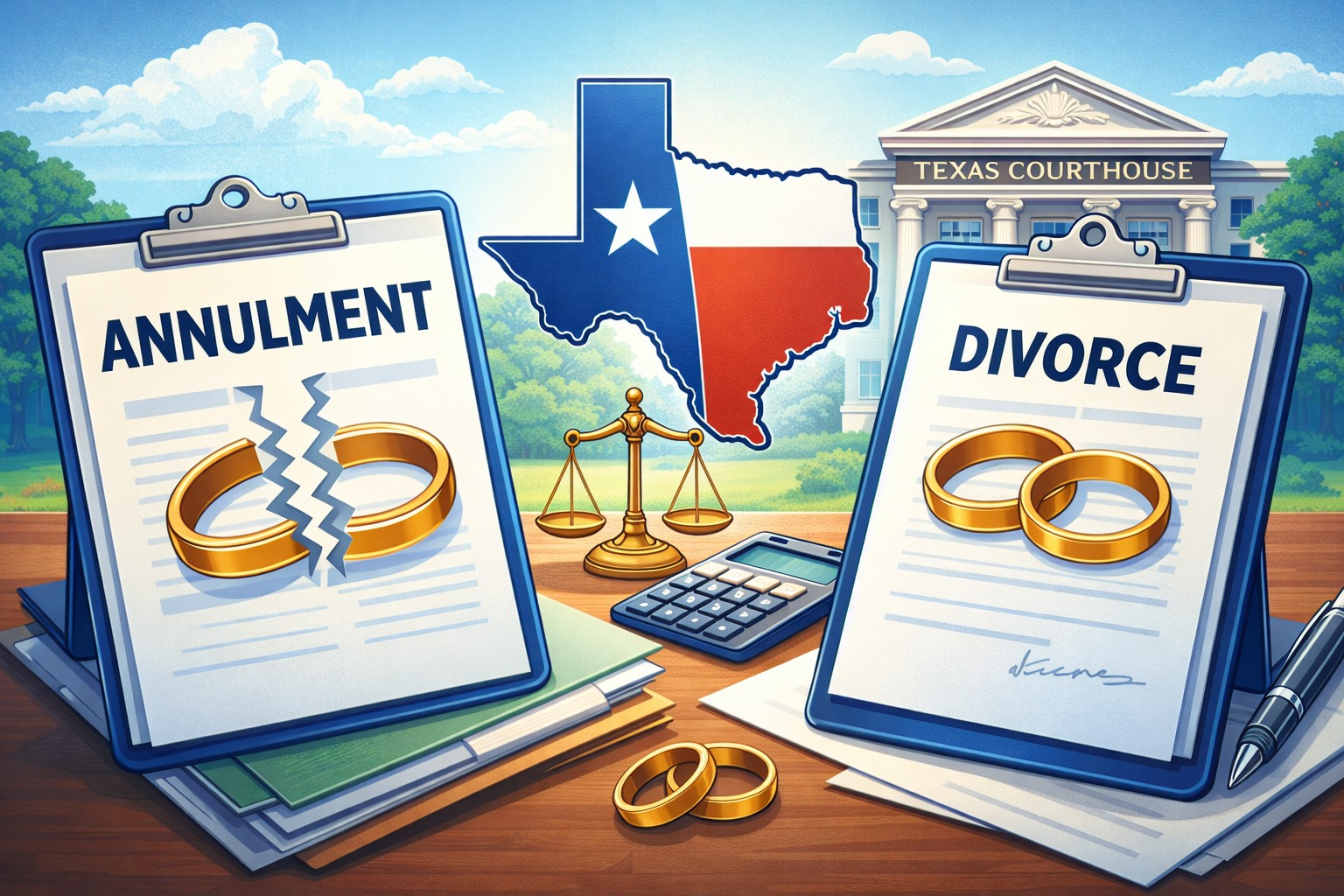
Many people assume annulment and divorce accomplish the same thing – ending a marriage. While both result in the parties no longer being married, they are very different legally, and the distinction can have important consequences.
In Texas, a divorce ends a valid marriage. An annulment, on the other hand, is a legal finding that the marriage was never valid to begin with.
Understanding the difference is critical, especially when deciding which legal path applies to your situation.
What Is a Divorce in Texas?
A divorce is the legal termination of a valid marriage. The court recognizes that the marriage existed but is now being dissolved.
In a Texas divorce, the court addresses issues such as:
-
Division of community property and debts
-
Child custody, visitation, and support
-
Spousal maintenance (in some cases)
Texas is a “no-fault” divorce state, meaning you do not have to prove wrongdoing. The most common ground is that the marriage has become insupportable due to conflict or discord.
Divorce is by far the most common way marriages end.
What Is an Annulment in Texas?
An annulment is different. Instead of ending a valid marriage, an annulment is a legal declaration that the marriage was invalid from the start.
If a court grants an annulment, it treats the marriage as though it never legally existed.
However, annulments are only available under specific circumstances defined by Texas law.
Legal Grounds for Annulment in Texas
Texas courts will not grant an annulment simply because someone regrets getting married. There must be a recognized legal basis.
Some common grounds include:
1. Fraud, Duress, or Force
If one spouse was induced into the marriage through fraud or forced into the marriage through threats or coercion, an annulment may be appropriate.
Examples may include deception about important facts or pressure that prevented voluntary consent.
2. Lack of Mental Capacity or Intoxication
If a spouse lacked the mental capacity to consent to the marriage, due to mental incapacity or intoxication, the marriage may be annulled if the parties did not voluntarily continue living together after capacity was restored.
3. Concealment of Divorce
If one spouse concealed the fact that they had recently divorced someone else, and the other spouse did not know, an annulment may be possible under certain conditions.
4. Marriage Occurring Too Soon After a Prior Divorce
Texas law prohibits remarriage within 30 days of a prior divorce unless waived by the court. A marriage that violates this rule may be subject to annulment.
5. Underage Marriage
If one spouse was under 18 and did not have proper legal authorization, the marriage may be annulled.
Annulment vs. Divorce: Property and Financial Issues
Many people assume annulment avoids property division. That is not always true.
Even in annulment cases, Texas courts may still address:
-
Division of property acquired during the relationship
-
Child custody and support
-
Other related issues
Texas courts use equitable principles to resolve these matters, even when a marriage is annulled.
Annulment vs. Divorce: Which Is Easier?
Annulments are generally more difficult to obtain than divorces.
Divorce requires proof that the marriage is insupportable. Annulment requires proof of specific legal grounds.
If those grounds do not exist, divorce is typically the appropriate option.
Does the Length of the Marriage Matter?
The length of the marriage alone does not determine whether annulment is available.
Even very short marriages may still require divorce unless legal grounds for annulment exist.
Conversely, annulment may be possible in some longer marriages if qualifying legal grounds are proven.
What About Children?
If children were born during the marriage, their legal rights are fully protected regardless of whether the case proceeds as an annulment or divorce.
Courts will still address:
-
Custody
-
Visitation
-
Child support
The child’s best interest remains the court’s primary concern.
Final Thoughts
Annulment and divorce both end a marital relationship, but they do so in very different ways. Divorce ends a valid marriage, while annulment is a legal determination that the marriage was never valid to begin with.
Because annulments require specific legal grounds, most marriages in Texas are ended through divorce rather than annulment.
If you are unsure which option applies to your situation, the experienced attorneys at Grinke Stewart Law can help you understand your rights and the best path forward. Contact us at 469-598-2001 to discuss your situation.