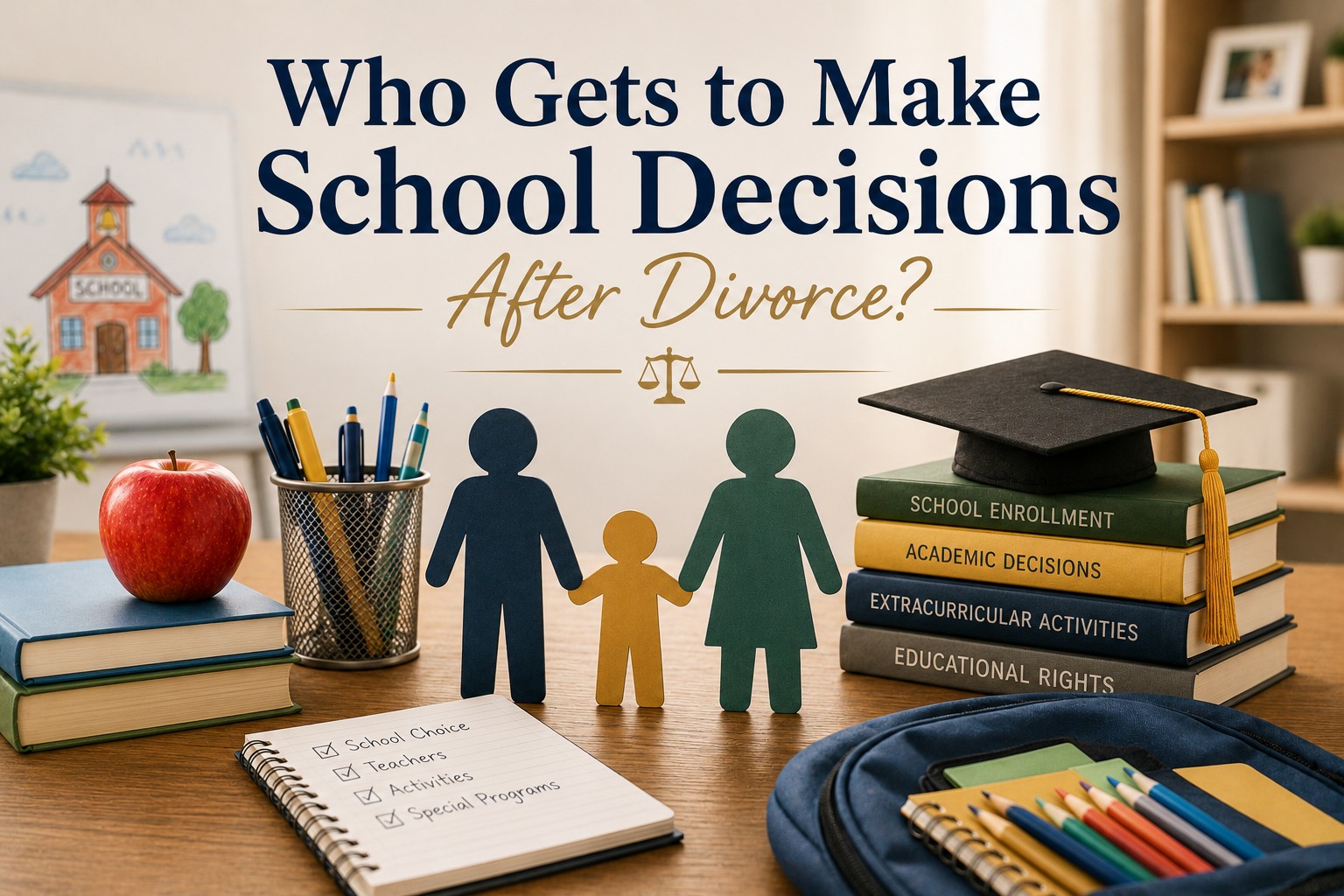
As the school year approaches, many divorced or separated parents begin asking questions like:
- Who decides where my child goes to school?
- Can my ex change schools without my permission?
- Do we both get to talk to teachers?
- What happens if we disagree about educational decisions?
The answers depend on the specific terms of your court order. Understanding who has the authority to make educational decisions can help prevent conflict and ensure your child starts the school year on the right foot.
Start With Your Court Order
One of the biggest misconceptions parents have is believing that “joint custody” means both parents have equal decision-making authority on every issue. In Texas, that’s not always the case. Every Final Decree of Divorce or SAPCR order spells out which parent has the authority to make certain decisions for the child.
Those rights can be:
- Exercised independently by either parent
- Exercised jointly by agreement
- Given exclusively to one parent
That’s why the first place to look is always your court order.
What Is a Joint Managing Conservatorship?
In Texas, most parents are appointed as Joint Managing Conservators (JMCs). Despite the name, that does not necessarily mean every decision must be made together. Instead, the court divides various parental rights and duties between the parents.
For educational issues, your order may provide that:
- Either parent can make certain decisions independently.
- Both parents must agree before making certain decisions.
- One parent has the exclusive authority to make a particular decision.
Every case is different.
What Is a Sole Managing Conservatorship?
In some situations, the court appoints one parent as the Sole Managing Conservator (SMC). This typically occurs when the court determines that giving one parent greater decision-making authority is in the child’s best interest. Depending on the order, that parent may have exclusive authority over many important decisions, including educational matters. Even then, the other parent may still have rights to receive information from the school and remain involved in the child’s education.
Who Chooses the School?
One of the most common questions is: “Who decides which school our child attends?”
There is no one-size-fits-all answer. The answer depends on your court order. For some families: both parents must agree. In others: one parent has the exclusive right to make that decision. In still others: the decision may effectively be determined by which parent has the exclusive right to designate the child’s primary residence.
If parents disagree, the issue sometimes requires mediation or court intervention.
Can Both Parents Talk to Teachers?
In many cases, yes. Unless a court order says otherwise, both parents often have the right to:
- Speak with teachers.
- Attend school events.
- Receive report cards.
- Access educational records.
- Participate in parent-teacher conferences.
Many schools allow both parents to be listed in the school’s communication system so each receives important updates directly. That can help reduce misunderstandings and keep both parents informed.
What Happens When Parents Disagree?
Disagreements happen. Parents may disagree about:
- Public versus private school
- Academic programs
- Tutoring
- Special education services
- Extracurricular activities
- School transfers
The first step should always be communication.
If your court order requires joint decision-making, both parents should make a genuine effort to discuss the issue and focus on what is best for the child—not what is most convenient for either parent.
Unfortunately, some disagreements cannot be resolved through conversation alone. In those situations, mediation may help. If mediation is unsuccessful, the court may ultimately need to decide the issue.
Don’t Put Your Child in the Middle
When parents disagree about school, children often feel caught between two people they love.
Avoid:
- Asking your child to choose sides.
- Using your child to deliver messages.
- Criticizing the other parent’s decisions in front of your child.
- Asking your child to convince the other parent.
School should remain a place where children can focus on learning—not adult conflict.
Communication Is Key
As the school year begins, parents can often avoid disputes by discussing important issues early, including:
- Transportation
- School supplies
- Parent-teacher conferences
- Extracurricular activities
- School calendars
- Emergency contacts
Planning ahead can prevent small disagreements from becoming much larger problems.
Final Thoughts
Educational decisions are some of the most important choices parents make after a divorce. While Texas law provides a framework, the specific rights and responsibilities of each parent are determined by the language of the court order. If you’re unsure who has the authority to make a particular school-related decision, don’t assume. Take the time to review your order—or speak with an experienced family law attorney who can help you understand your rights and obligations.
A little clarity now can help avoid significant conflict later.
Need Help With a School-Related Custody Issue?
As a new school year begins, questions about educational decision-making often arise. Whether you’re facing a disagreement over school enrollment, educational rights, or another custody issue, the Grinke Stewart Law team can help you understand your options and work toward a solution that keeps your child’s best interests at the center of every decision. Contact us at 469-598-2001 to discuss your situation.