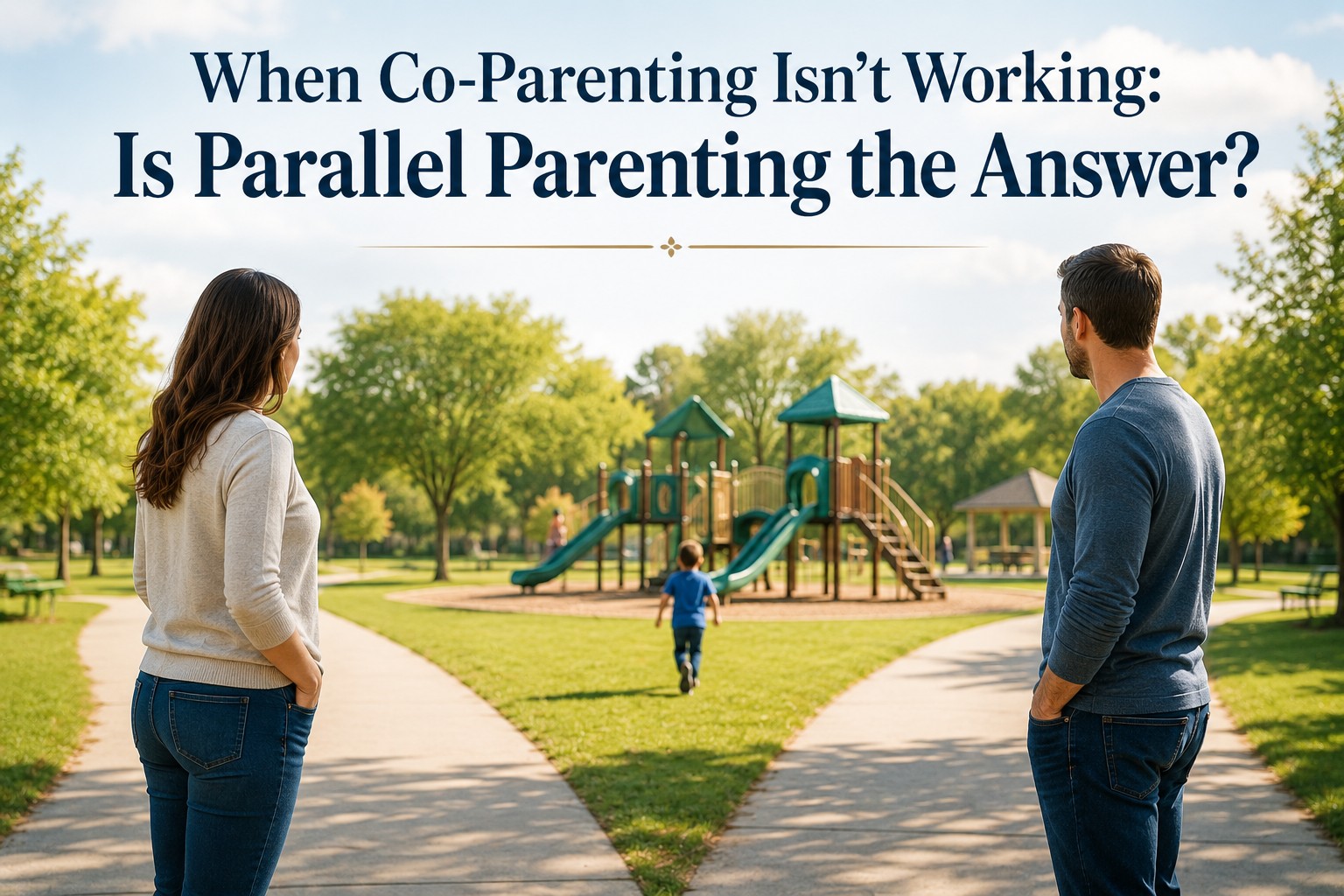
For many parents going through a divorce or custody case, the goal is simple:
“We want to co-parent successfully.”
It’s a great goal and for many families, it works well. Healthy co-parenting allows parents to communicate effectively, make joint decisions, and provide stability for their children despite living in separate households.
But what happens when one parent simply refuses to cooperate? What if every conversation turns into an argument? What if every text message leads to conflict?
At some point, the question becomes: Is continuing to force co-parenting actually helping anyone?
The answer may be that it’s time to consider a different approach: parallel parenting.
What Is Co-Parenting?
Co-parenting generally means that parents work together to raise their children despite no longer being in a relationship.
Successful co-parenting often includes:
- Respectful communication
- Joint decision-making
- Flexibility
- Shared information about school, medical care, and activities
- A willingness to put the children’s needs first
It requires cooperation from both parents. And that’s the key.
The Problem: You Can’t Co-Parent by Yourself
One of the biggest misconceptions is that if one parent just tries harder, eventually things will improve. Unfortunately, that’s not always true. Co-parenting only works when both parents are willing to participate in good faith.
If one parent consistently:
- Creates unnecessary conflict,
- Refuses to communicate,
- Manipulates situations,
- Uses the children as messengers,
- Constantly changes plans,
- Or looks for opportunities to argue
then the relationship may no longer resemble healthy co-parenting. Trying harder often just leads to more frustration.
Signs Co-Parenting May No Longer Be Working
Every family has disagreements. The issue isn’t whether conflict exists. The question is whether the conflict has become the relationship.
Some warning signs include:
- Every conversation becomes an argument.
- You dread receiving text messages.
- Communication is filled with accusations or insults.
- Schedule changes become battles instead of simple discussions.
- The children are repeatedly caught in the middle.
- Every decision turns into a power struggle.
When conflict becomes constant, it’s worth asking whether a different parenting approach would better serve the children.
What Is Parallel Parenting?
Parallel parenting is designed for high-conflict situations. Rather than trying to maintain a close parenting partnership, parents reduce unnecessary interaction while continuing to meet their responsibilities.
Parallel parenting often includes:
- Limited communication
- Clear schedules
- Predictable routines
- Written communication instead of phone calls
- Fewer opportunities for conflict
The focus shifts from working together to parenting successfully alongside one another.
Parallel Parenting Is Not Giving Up
Some parents feel guilty when they realize co-parenting isn’t working. They worry they’re “failing.” In reality, choosing a parenting structure that reduces conflict is often one of the healthiest decisions a parent can make.
Children generally benefit from:
- Less exposure to conflict
- Greater consistency
- Predictable routines
- Parents who are emotionally calmer
Sometimes reducing communication actually improves the child’s environment.
How Technology Can Help
In high-conflict situations, communication often benefits from additional structure. Many families successfully use co-parenting apps to:
- Share calendars
- Exchange information
- Track expenses
- Keep communication organized
When conversations remain brief, factual, and child-focused, unnecessary conflict often decreases.
Focus on What You Can Control
One of the hardest lessons in high-conflict cases is this: You cannot control how the other parent behaves. You can only control:
- How you communicate
- How you respond
- How you model behavior for your children
- Whether you stay focused on your child’s best interests
Trying to “win” every disagreement rarely benefits anyone, especially the children.
What Courts Want to See
Texas courts generally encourage parents to foster healthy relationships between children and both parents whenever possible. That doesn’t mean parents must communicate constantly. In many high-conflict cases, judges appreciate parenting arrangements that reduce unnecessary conflict while ensuring the children’s needs continue to be met. The goal isn’t perfect cooperation. The goal is a healthy environment for the children.
Final Thoughts
Co-parenting is an excellent goal, but it is not always realistic. If one parent refuses to communicate respectfully or conflict has become constant, continuing to force co-parenting may create more stress than stability. For some families, parallel parenting isn’t a step backward—it is a healthier path forward.
The measure of success isn’t how often parents communicate. The measure of success is whether the children are growing up in a stable, loving environment with as little conflict as possible.
Need Help Navigating a High-Conflict Custody Case?
Every family is different, and there is no one-size-fits-all parenting plan.
If you’re struggling with ongoing co-parenting conflict, an experienced Texas family law attorney at Grinke Stewart Law can help you evaluate your options and develop a strategy that prioritizes your child’s best interests while reducing unnecessary conflict. Call us today to discuss your situation 469-598-2001.