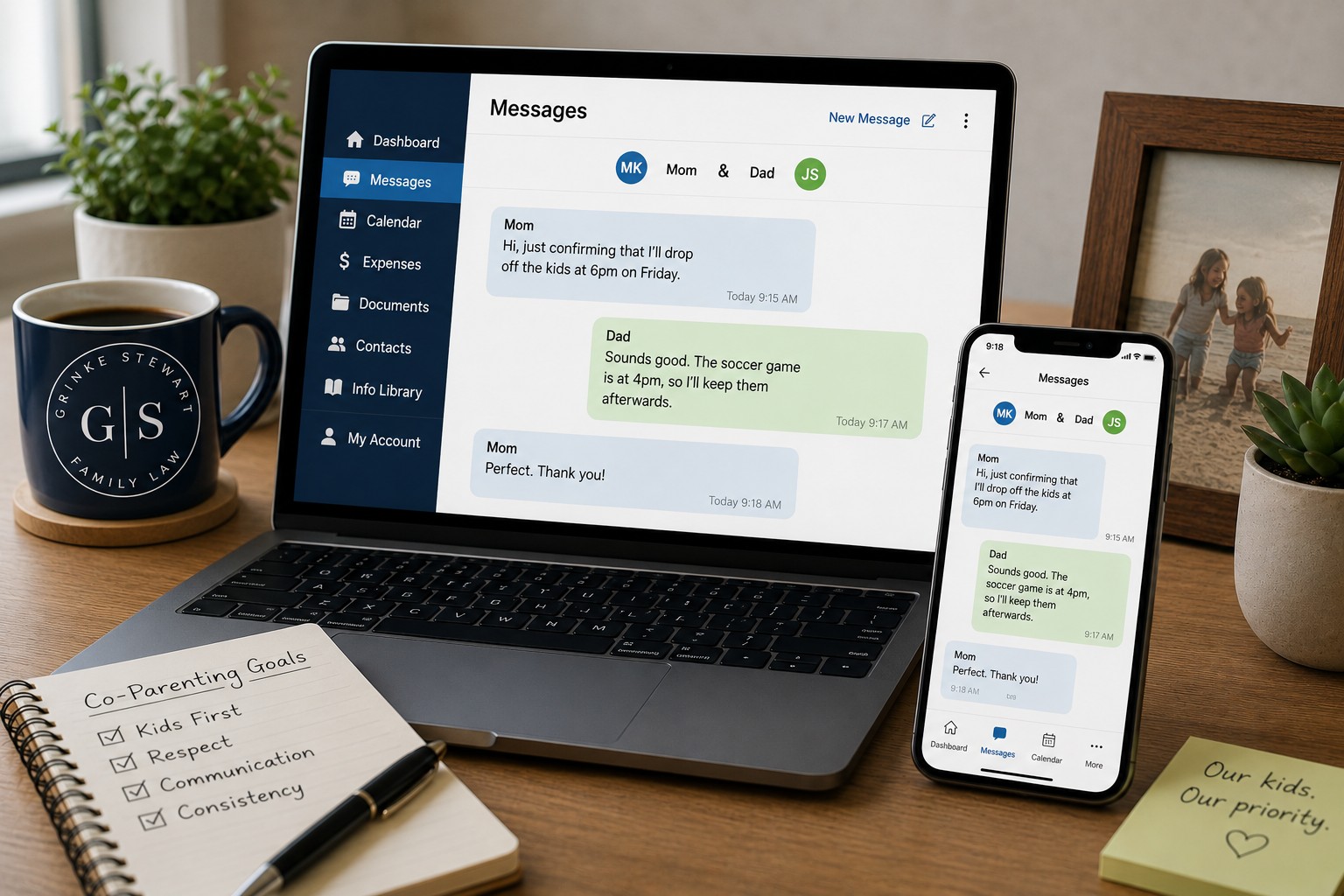
In many custody and co-parenting cases, one of the biggest ongoing challenges is communication.
Even after court orders are signed, parents often continue struggling with:
- Miscommunication
- Missed exchanges
- Schedule confusion
- Arguments over conversations or agreements
- Tension surrounding the children
That is one reason co-parenting apps have become increasingly common in family law cases.
But many parents wonder:
“Do these apps actually help?”
The answer is: They can, especially in high-conflict situations.
The goal of a co-parenting app is usually not to make parents become best friends. The goal is to create:
- Better organization
- Clearer communication
- Accountability
- Reduced conflict
Here is what co-parenting apps actually help with, and where they do not magically solve problems.
Why Courts and Attorneys Often Recommend Co-Parenting Apps
In high-conflict cases, communication itself often becomes part of the problem.
Parents may argue about:
- What was said
- Whether messages were received
- Schedule changes
- Medical information
- School updates
- Pick-up/drop-off details
Co-parenting apps create a centralized system for communication and scheduling.
That structure alone can reduce a surprising amount of conflict.
What Co-Parenting Apps Commonly Include
Most co-parenting platforms offer features like:
- Messaging
- Shared calendars
- Expense tracking
- Document storage
- Medical and school information
- Parenting schedules
Some apps also maintain communication logs that cannot easily be altered or deleted.
What These Apps Actually Help With
1. Reducing “He Said / She Said” Disputes
This is one of the biggest benefits.
Instead of arguments about:
- missed texts,
- deleted messages,
- or verbal conversations,
the communication is stored in one place.
That can create:
- clarity,
- accountability,
- and a more reliable communication history.
2. Keeping Communication More Focused
Interestingly, many parents communicate more calmly when they know messages are:
- documented,
- organized,
- and reviewable later.
The structure of an app often naturally reduces:
- emotional texting,
- impulsive reactions,
- and constant back-and-forth conflict.
3. Improving Scheduling and Organization
Shared calendars can help parents track:
- possession schedules,
- holidays,
- extracurricular activities,
- medical appointments,
- school events.
This reduces confusion and helps both parents stay informed.
4. Helping Create Boundaries
For many parents, especially in high-conflict cases, constant texting can become emotionally exhausting.
Co-parenting apps can help create healthier boundaries by:
- limiting unnecessary communication,
- centralizing conversations,
- and reducing repeated interruptions throughout the day.
5. Providing Better Documentation
Documentation matters in family law cases.
Apps can provide organized records of:
- communication,
- schedule changes,
- reimbursement requests,
- parenting coordination.
That can become important if disputes later arise.
What Co-Parenting Apps Do NOT Fix
This part is important.
A co-parenting app does not:
- eliminate conflict,
- fix unhealthy communication patterns,
- make someone cooperative,
- or solve deeper parenting disagreements.
If one parent is consistently hostile, manipulative, or unreasonable, an app alone will not change that behavior.
The app is a tool, not a cure.
Commonly Used Co-Parenting Apps
Some of the most commonly used apps include:
📱 OurFamilyWizard
Often recommended in higher-conflict cases.
Known for:
- detailed communication records,
- calendars,
- expense tracking,
- and organizational tools.
Many attorneys and courts are familiar with it.
📱 TalkingParents
Another commonly used option.
Popular because:
- communication records are preserved,
- messages are organized,
- and it is relatively user-friendly.
📱 AppClose
A free option some parents prefer.
Includes:
- scheduling,
- messaging,
- expense tracking,
- and shared calendars.
Which App Is “Best”?
That depends heavily on:
- the level of conflict,
- the personalities involved,
- the budget,
- and the specific communication issues.
Some parents need:
- extensive documentation tools.
Others simply need:
- better scheduling organization.
The Biggest Mistake Parents Make With These Apps
Many parents treat co-parenting apps like:
- emotional battlegrounds,
- evidence-building platforms,
- or ongoing arguments.
That usually makes things worse.
The most effective communication is usually:
- brief,
- factual,
- child-focused,
- and emotionally neutral.
Final Thoughts
Co-parenting apps are not magic solutions.
But in many cases, they can:
- reduce confusion,
- improve accountability,
- create healthier boundaries,
- and lower the temperature of communication.
For some families, that structure can make a significant difference. Especially in high-conflict cases, better organization and calmer communication often benefit not just the parents, but the children as well.
Navigating a High-Conflict Co-Parenting Situation?
Communication issues are one of the most common sources of ongoing custody conflict.
If you are dealing with co-parenting disputes, custody concerns, or enforcement issues, the experienced attorneys at Grinke Stewart Law can help you better understand your options and strategies moving forward. Call us at 469-598-2001 to discuss your family law situation.